Home
Zeppelins
1898 - 1913| Balloons |
| Airships |
| Zeppelins |
| Santos-Dumont |
| Henry Farman |
| Wrights in France |
| The Channel |
| Rheims |
| London-Manchester |
| Chavez flies Alps |
| Round Britain Race |
| Roland Garros |
| Aerobatics |
| Europe to Egypt |
| The Men |
| The Machines |
| Bibliography & Links |
The next year he was able to make his ideas reality by constructing Luftschiff Zeppelin No.1 ("Zeppelin Airship No.1") or LZ-1. The envelope was a huge 420 feet long, and contained 17 gas bags, totalling 400,000 cubic feet in volume. Suspended below were two separate gondolas which each sported a 15 h.p. Daimler engine. This gigantic machine was tested on Lake Constance in the south of Germany. The lake had a dual purpose of providing a large flat space, and a soft landing should anything go wrong! The Zeppelin was housed in a floating, moveable hanger some distance from the shore, so that it could always be taken out sheltered from the wind. Three flights were made on 3 July and on 17 and 21 October 1900, which convinced Count Zeppelin that he still had a lot to learn about airship control and construction techniques. He went back to the drawing board and replaced his brainchild with an improved version.
LZ-2 did not fly until 1905 and then it was unluckily short-lived. It was slightly smaller than Zeppelin No.1 but carried two 85 h.p. Daimlers for greater controllability. It was wrecked in a gale and scrapped. LZ-3 flew successfully in October 1906 and was replaced in 1908 by LZ-4.

LZ-4
over Munich in 1908
LZ-4 caught fire in a storm during a forced landing at Echterdingen on 5 August 1908. Count Zeppelin's private fortune was by now exhausted and he could not afford to build a replacement. A fund was started to raise money and the German people, in a burst of patriotic enthusiasm, rapidly came to his aid. This episode became known as the "miracle of Echterdingen". The resulting airship was christened the "Zeppelin II", because to the public the destroyed one was simply "the Zeppelin" (but it was in fact Count Zeppelin's fifth machine). It was 446 ft. long and had a capacity of more than half a million cubic feet of hydrogen gas. On its third flight it beat all previous endurance records with an epic flight lasting 37.5 hours. During this time the airship travelled 602 miles and only stopped because it had run out of petrol. It came down at Jebenhausen near Groppingen on 31 May 1909, and unfortunately collided with a well-rooted pear tree which demolished the front end. With considerable skill and confidence, the crew proceeded to amputate the damaged section (three gas cells out of 17), lightened the nose by removing one of the two 110 h.p. Daimler engines, and rigged up a replacement nose. It then flew back to Lake Constance on one engine for repairs.
Later in 1909 Count Zeppelin achieved a long-held ambition of flying from Lake Constance to Berlin. On board as passengers on the voyage, which started on 27 August, were the Crown Prince of Germany and the King of Wurtemberg. After a trip of two days broken by overnight stops, LZ-6 (confusingly also named "Zeppelin III") arrived in Berlin to be greeted by the Empress. The continuing support of the German Government allowed the Count to develop more and more advanced models.
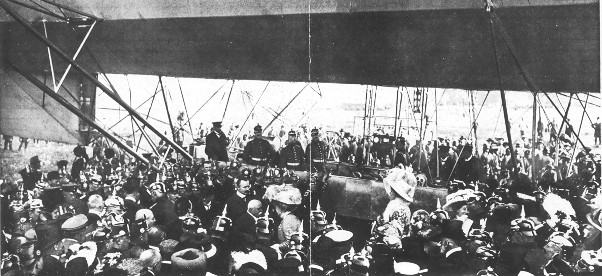
The LZ-6 arrives
in Berlin and von Zeppelin is greeted by the German Empress
LZ-7, named the "Deutschland", was built as a passenger Zeppelin and started a line of similar civilian airships. Before the First World War Zeppelins were running scheduled air services between German cities, and, despite their subsequent reputation, carried around 20,000 people without a single accident. These were the first passenger air services anywhere in the world.
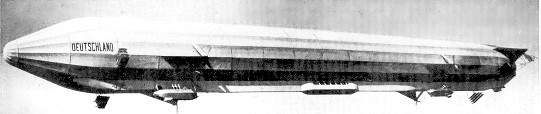
The world's first airliner
- the Zeppelin Deutschland of 1910
The
Deutschland
was
wrecked on 28 June 1910 and was replaced by the
Ersatz Deutschland
in 1911. On 16 May 1911 it collided with its hanger roof and broke its
back, with the passengers being rescued by fireman's ladder. Despite the
difficulties of Zeppelin operation and their unproven military usefulness,
the German Government persevered in funding their development, partly because
it would hurt national pride to back down, and partly for the excellent
reason that large airships still seemed like the most probable future means
of mass air transportation.
| <Previous |
|
Next> |
Balloons
· Airships · Zeppelins
· Santos-Dumont · Farman
· Wrights in France · The
Channel · Rheims · London
- Manchester
Chavez
· Round Britain Race · Garros
· Aerobatics · Egypt
· Men ·
Machines
·
Bibliography & Links