| Home |
Europe's First Flight |
| Despite
the Wright brothers having made the first sustained and controllable flight
in December 1903, European experimenters were extraordinarily slow to match
their achievement. One reason was the Wright's understandable desire to
make some money from their ground-breaking invention. They were wary (and
not without reason) of giving public demonstrations until all their patents
had been approved. They were also in talks with the U.S. Military and felt
it prudent to bring these to a conclusion first.
The Wright's low-key approach naturally created some confusion as to just what the brothers had achieved. Back in Europe 'respectable' inventors were able to downplay the Wright's significance. If a couple of bicycle mechanics from the States really had cracked the age-old problem of flight, why had they not given a proper demonstration flight before qualified experts? It was the opinion of the chairman of the French Aero Club that the Americans had made only a "slight advance" on French efforts. As a result of such doubts the first sustained European flight was not made until 1906. And even then it was considerably less controlled than the Wrights'.
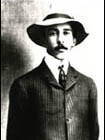
"During the long sunny afternoons in Brazil, half sung to sleep by the humming of the insects and the distant cry of some bird, lying in the shade of the varanda, I passed hours and hours contemplating the Brazilian sky and admiring the ease with which the birds, with their wide- stretched wings, reached the great heights. Gazing at the clouds that floated gladly in the pure sunlight, I was stirred by a sense of freedom."Thus inspired, he began experimenting with small airships of his own design, and achieved considerable success flying them over Paris during the early 1900s. Thanks to his endearing habit of tethering his dirigibles to lamp-posts while he visited friends or went to the Opera, he became a much-loved character in the Parisian scene. Then in 1904 he visited the St.Louis Exposition in America, where he met Octave Chanute. Chanute was effectively the Wrights' 'mentor' and from him Santos-Dumont learnt something of the brothers' successful flights of 1903 and 1904. When he returned to Europe he built his first heavier-than-air machine - an unsuccessful helicopter design. Then in 1906 he built his first aeroplane. |
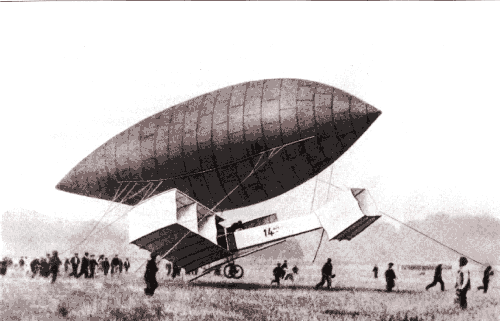
This
he named the '14-bis', due to its being first tested slung beneath
his No.14 airship. ('Bis' roughly translates as 'mark 2'.) It was essentially
two large boxkite wings and a covered
fuselage, with a smaller boxkite cell at one end to act as a combined rudder
and elevator. No expense was spared: the framework was of bamboo poles
and aluminium tube, which was covered with Japanese silk. For his powerplant
he chose the first purpose-designed aeroengine, the 24hp Antoinette
V8, driving an all metal propellor. The result was a machine of 'conventional'
layout, but which, unbelievably to modern eyes, flew 'backwards!' (In fact
it was what is now called a canard
design.)
The 14-bis slung beneath airship No.14 for tests |
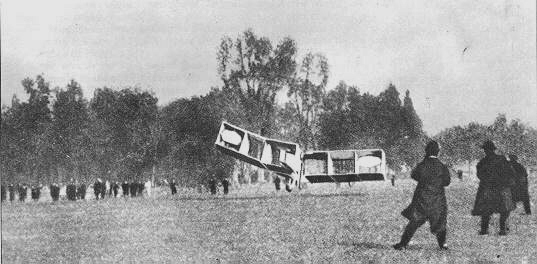
| French newspaper account of the flight | Santos-Dumont
took his machine to the Bagatelle park on the outskirts of Paris for flight
tests, and on 13 September 1906 he got airborne in a short hop of seven
metres. However he damaged the undercarriage on landing, and the 14-bis
had to undergo repairs. While these were being
made, he swapped the 24hp engine for the more powerful 50hp version of
the Antoinette. On 23 October he returned to Bagatelle and, in front
of a large crowd including officials of the Aéro-Club de France,
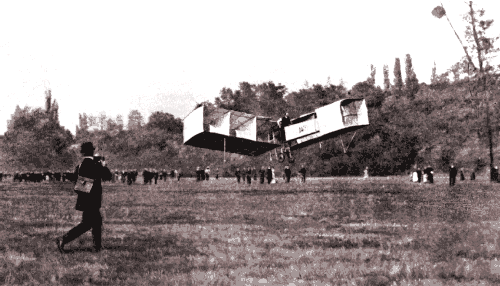
made a much improved hop-flight of 60 metres. This effort won him a cup
worth 3,000 francs, offered by the chairman of the Aéro-Club,
Ernest Archdeacon, for the first flight of over 25 metres.
Before his next flight Santos-Dumont modified the 14-bis by the addition of large hexagonal ailerons, to give some control in roll. Since he already had his hands full with the rudder and elevator controls (and could not use peddles since he was standing up), he operated these via a harness attached to his chest. If he wanted to roll right he would lean to his right, and vice versa. One witness likened Santos-Dumont's contortions while flying the 14-bis to dancing the samba! With the modified aircraft, he returned to Bagatelle on 12 November. This time the Brazilian made six increasingly successful flights. On the last the 14-bis flew for 220 metres (in 21 seconds) at a height of about 5 metres (15 feet). Towards the end of the run the machine began to turn, and Santos-Dumont successfully worked his ailerons to straighten up before bringing the 14-bis to a gentle touch-down. It was a magnificent personal effort. This time he won the Aéro-Club prize of 1,500 francs cash for the first 100 metre flight.
|
| *"A new era has begun!" | Incredibly
modest though these flights had been compared with those the Wrights had
been achieving in semi-private, they caused a sensation across Europe.
(The world at large was not to have proof of the Wrights' achievements
for another two years.) "Une ère nouvelle commence!"* exclaimed
fellow pioneer Ferdinand Ferber; and the little Brazilian was widely credited
with having invented the aeroplane. However by comparison to the Wright
Flyer,
the 14-bis was poorly controlled indeed. It made only one more outing,
on 4 April 1907, before being abandoned by Santos-Dumont in favour of better
types in 1908 and 1909. However, Santos-Dumont had already left a unique
mark on aviation.
Balloons
· Airships · Zeppelins
· Santos-Dumont · Farman
· Wrights in France · The
Channel · Rheims · London
- Manchester
|