Home
Henry Farman
and the First Cross-Country
On 29 May 1908, Farman took the first passenger in Europe into the air. Appropriately enough it was Ernest Archdeacon, the man who had done so much to encourage aviation in France since 1903.
 The
only other prominent aviator during this period was Léon Delagrange
who, like Farman, had purchased a standard Voisin in 1907. However he was
less technically-minded than Henry and had made only a few modifications
to the basic design. Gabriel Voisin remarked that in contrast to Farman,
Delagrange "was not the sporting type" and knew nothing about running
an engine. Nevertheless a sporting rivalry seems to have developed between
the two fliers. In the summer of 1908, Delagrange went south to Italy to
demonstrate the art of flying while Farman went north to Belgium. On 23
June, Delagrange set an endurance record of 18 minutes, 30 seconds at Milan:
Farman retaliated with 20 minutes, 20 seconds at Ghent, on 6 July. On 6
September Delagrange flew for 25km (15 miles) at Issy: Farman bested that
with 40km (25 miles) at Champ de Chalons on 2 October.
The
only other prominent aviator during this period was Léon Delagrange
who, like Farman, had purchased a standard Voisin in 1907. However he was
less technically-minded than Henry and had made only a few modifications
to the basic design. Gabriel Voisin remarked that in contrast to Farman,
Delagrange "was not the sporting type" and knew nothing about running
an engine. Nevertheless a sporting rivalry seems to have developed between
the two fliers. In the summer of 1908, Delagrange went south to Italy to
demonstrate the art of flying while Farman went north to Belgium. On 23
June, Delagrange set an endurance record of 18 minutes, 30 seconds at Milan:
Farman retaliated with 20 minutes, 20 seconds at Ghent, on 6 July. On 6
September Delagrange flew for 25km (15 miles) at Issy: Farman bested that
with 40km (25 miles) at Champ de Chalons on 2 October.
Finally, Farman made the logical next step of flying between two places, rather than simply making measured circuits over the safety of an aerodrome. On 30 October 1908 he flew the 27km from his camp at Bouy to the cavalry ground at Rheims in just under 20 minutes. It was the first cross-country flight in Europe.
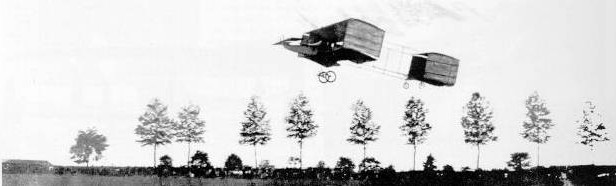
Farman takes
off from Bouy on 30 October 1908. Note 'side-curtains' between the wings.
This is his account of the flight:
- At
first I was a bit emotional ... The departure for the first journey had
rather alarmed me. What, I asked myself, am I going to do when I arrive
above those large poplars that I can see way over there, in the direction
of Mourmelon-le-Petit? For the moment, all is well. The ground is flat
and the countryside very agreeable.
But, during these reflections the poplars are growing in an astonishing fashion. The crows, who were holding a squawking gathering, are flying off horrified at my approach. Ah! those 100 ft. poplars! Should I pass them on the right? on the left? My indecision does not last long, for I am scarcely 50 yards from the vast high grove. Oh well, here goes! A touch on the elevator and the aircraft rises up rapidly; it goes over, while with an anxious eye I look to see whether I am clearing the tree-tops.
My tranquility is, however, short-lived. Here is the Mourmelon windmill and now Mourmelon itself. Bah! I thought, One only dies once! The windmill, the village, the railway - I go over them all. A critical moment in an emotional journey. And then, I'm not sure about the height. I am told I was flying at 150 ft. Maybe I was, because I went up as high as possible so as not to be caught by the poplars.
I was giving my full attention to steering the machine, to the noise of the motor which 'mis-fired' from time to time and worried me, to the roaring of the propeller. But I nevertheless enjoyed, at that instant, the greatest joy of my life: the charm of gliding above my fellow men while the scenery flew by in strips and where, from all sides, people were running towards me who seemed tiny, tiny. At that moment I found myself in pure air, carressed by a gentle breeze, and the sun lit up the way, limpid and serene. It is my most cherished memory.
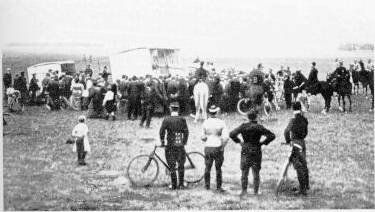
Farman on the cavalry ground at Rheims