Channel Crosser
[Gap]

Thanks to Louis Blériot's sensational flight across the Channel in 1909, the Blériot No.XI, or 'Channel crossing type' as it was often known, became one of the most popular pre-war aircraft.
The first XI flew on 18 January 1909 (with an unsatisfactory R.E.P. engine) after being displayed at the French Aero Show in the Grand Palais, Paris. The XI did not have ailerons, as many of Blériot's earlier designs had, but instead used wing-warping to control bank. The elevators took the form of pivoting panels at the wing tips of the tailplane. The rudder was relatively small and there was no fixed fin. In fact, the uncovered section of fuselage aft of the cockpit created enough drag to stabilize the machine laterally. This was quite unintentional on Blériot's part. Had the whole fuselage been covered, there would actually have been less lateral stability, despite the greater side surface area. The wings were braced from two linked pylons above, and one below, the fuselage. A wide steel frame, looking rather like an iron bedstead, had the dual purpose of carrying the wide castoring undercarriage and providing a firm mounting for the engine. Because the wheels castored, the machine could, theoretically, be landed in a cross-wind travelling sideways! The rest of the structure was made up of oak and poplar wood, reinforced with piano wire.
The Channel crossing XI flew with a 25 h.p. three cylinder Anzani radial engine, but later models were fitted with the better Gnôme rotary once it became available in quantity in 1910. The cylinders of the Anzani were set 70 degrees apart, and the cylinder wall, head and inlet were all made from one casting. The cylinders were not spaced regularly (120 degrees) because it was feared that the bottom ones would receive too much lubrication. Balancing weights were fitted to the crankshaft in order to compensate for this unequal thrust. The pistons travelled 120 mm. and the cylinders were 150 mm. diameter.
The Gnôme solved the problem of unequal lubrication and over-heating by rotating about its axis. The crankshaft was fixed to the plane and the propeller was fixed to the engine, instead of the other way round. This meant that high power could be achieved without heavy water jackets and radiators for cooling. Rotary engines also ran very smoothly. However, they were wasteful of oil, which passed through the cylinders with the petrol and was squirted out the exhausts. Rotaries were always cowled to prevent the oil from spraying over the plane and pilot. The first Gnômes had seven cylinders and produced about 60 h.p.
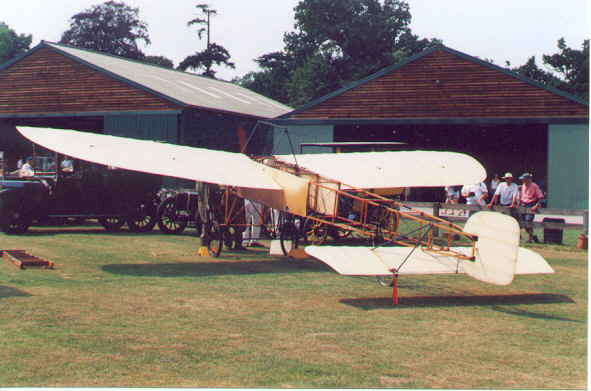
1910 Blériot
XI in the Shuttleworth Collection. The red tapes hanging from the tailplane
mark the start of the hinged elevator section.
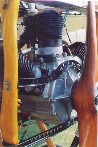
25 hp Anzani engine |
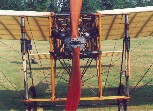
'Bedstead' undercarriage and engine mount |
Controls and cockpit |
The XI
proved popular with amateur fliers and serious competitors alike, with
numerous records being set on it. In 1910 a Blériot XI would
cost a private buyer £400, engine included. A two-seat version was
also produced for military use, the Blériot XI-2.
| Specifications:
Engine - 25 hp Anzani radial Prop diameter - 6 ft. 7 in. |
Wing
span - 25 ft. 6 in.
Wing area - 150 sq. ft. Speed - 36 mph |
| <Back |
|
Balloons
· Airships · Zeppelins
· Santos-Dumont · Farman
· Wrights in France · The
Channel · Rheims · London
- Manchester
Chavez
· Round Britain Race · Garros
· Aerobatics · Egypt
· Men ·
Machines
·
Bibliography & Links