The Machines
| Balloons |
| Airships |
| Zeppelins |
| Santos-Dumont |
| Henry Farman |
| Wrights in France |
| The Channel |
| Rheims |
| London-Manchester |
| Chavez flies Alps |
| Round Britain Race |
| Roland Garros |
| Aerobatics |
| Europe to Egypt |
| The Men |
| The Machines |
| Bibliography & Links |
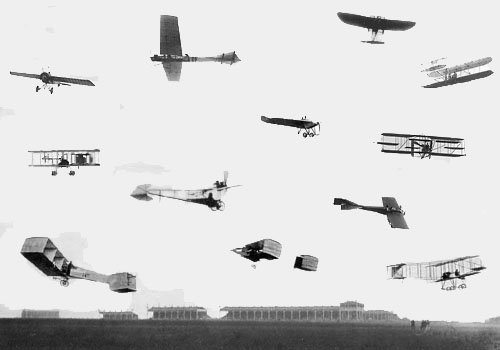
Select a link below or click on the image map
[Antoinette VII] [Blériot XI] [Bristol Boxkite] [Deperdussin B] [Cody 'Cathedral'] [Farman III] [Morane-Saulnier G]
[Nieuport IVG] [Santos-Dumont 14bis] [Santos-Dumont Demoiselle] ['Standard' Voisin] [Wright Type A]
 Antoinette
VII. Designed by Léon Levavasseur, who was an artist as well
as a gifted engineer, the Antoinette range possessed an almost art nouveau
sense of elegance. The engine, also named 'Antoinette', came first, being
designed by Levavasseur in 1903 to power motor boats. Both Santos-Dumont
and the Voisins used this engine to power their early
machines. The motor was of advanced design, utilising direct fuel injection
and evaporative steam cooling - which took place in long tubes fixed along
the sides of the fuselage. The
airframe was also innovative, making use of tapered double surface wings
for the first time. The pilot's controls consisted
of a rudder bar, and two hand-wheels
either side of the cockpit to control pitch
Antoinette
VII. Designed by Léon Levavasseur, who was an artist as well
as a gifted engineer, the Antoinette range possessed an almost art nouveau
sense of elegance. The engine, also named 'Antoinette', came first, being
designed by Levavasseur in 1903 to power motor boats. Both Santos-Dumont
and the Voisins used this engine to power their early
machines. The motor was of advanced design, utilising direct fuel injection
and evaporative steam cooling - which took place in long tubes fixed along
the sides of the fuselage. The
airframe was also innovative, making use of tapered double surface wings
for the first time. The pilot's controls consisted
of a rudder bar, and two hand-wheels
either side of the cockpit to control pitch and roll. The Antoinette IV, in which
Latham
first attempted to cross the English Channel, made use of large ailerons
hinged from the trailing edge. But the Antoinette VII, which went into
production later in 1909 used wing-warping
instead. Construction was of ash and spruce, with the front of the fuselage
being covered with cedar panels and the other surfaces with rubberised
fabric. Specifications:- span 42 ft.
0 in. (12.8 m.) - length 37 ft. 9 in. (11.5 m.) - height
9 ft. 10 in. (3 m.) - wing area 538.2 sq.ft. (50 sq.m.) - take-off
weight 1,301 lb. (590 kg) - speed 43 mph (70 kph).
and roll. The Antoinette IV, in which
Latham
first attempted to cross the English Channel, made use of large ailerons
hinged from the trailing edge. But the Antoinette VII, which went into
production later in 1909 used wing-warping
instead. Construction was of ash and spruce, with the front of the fuselage
being covered with cedar panels and the other surfaces with rubberised
fabric. Specifications:- span 42 ft.
0 in. (12.8 m.) - length 37 ft. 9 in. (11.5 m.) - height
9 ft. 10 in. (3 m.) - wing area 538.2 sq.ft. (50 sq.m.) - take-off
weight 1,301 lb. (590 kg) - speed 43 mph (70 kph).
 Blériot
XI. Louis Blériot drew
on the talents of Raymond Saulnier in the design of his eleventh machine,
which proved to be a huge success. The prototype flew with a 30 hp R.E.P.
radial engine, but this was replaced with a 25 hp Anzani for his famous
Channel
crossing flight. Once it became available in 1910, the Blériot was
usually fitted with a 50 hp Gnôme rotary. The pilot's controls were
of the type that has since become conventional although wing-warping
was used in favour of Blériot's more usual ailerons
in this design. Strangely, the uncovered section of the fuselage actually
contributed to directional stability owing to the drag
it caused. Moveable panels at the tips of the tailplanes acted as elevators.
Construction was of ash, bamboo and steel tube. The surfaces were covered
with rubberised fabric. The Blériot inspired a rash of similar monoplanes
from other constructors such as Morane-Saulnier,
Nieuport, Deperdussin, Humber, Blackburn and Fokker. Specifications:-span
25 ft.7 in. (7.8 m.) - length 26 ft. 3 in. (8 m.) -
height
8 ft. 6.5 in. (2.6 m.) - wing area 150.7 sq.ft. (14 sq.m.) - take-off
weight 661 lb. (300 kg) - speed approx. 47 mph (75 kph). [More...]
Blériot
XI. Louis Blériot drew
on the talents of Raymond Saulnier in the design of his eleventh machine,
which proved to be a huge success. The prototype flew with a 30 hp R.E.P.
radial engine, but this was replaced with a 25 hp Anzani for his famous
Channel
crossing flight. Once it became available in 1910, the Blériot was
usually fitted with a 50 hp Gnôme rotary. The pilot's controls were
of the type that has since become conventional although wing-warping
was used in favour of Blériot's more usual ailerons
in this design. Strangely, the uncovered section of the fuselage actually
contributed to directional stability owing to the drag
it caused. Moveable panels at the tips of the tailplanes acted as elevators.
Construction was of ash, bamboo and steel tube. The surfaces were covered
with rubberised fabric. The Blériot inspired a rash of similar monoplanes
from other constructors such as Morane-Saulnier,
Nieuport, Deperdussin, Humber, Blackburn and Fokker. Specifications:-span
25 ft.7 in. (7.8 m.) - length 26 ft. 3 in. (8 m.) -
height
8 ft. 6.5 in. (2.6 m.) - wing area 150.7 sq.ft. (14 sq.m.) - take-off
weight 661 lb. (300 kg) - speed approx. 47 mph (75 kph). [More...]
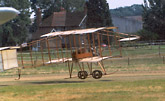 Bristol
Boxkite. When the British & Colonial Aeroplane Co. (later known
as the Bristol Aeroplane Co.) unveiled its 'Boxkite' in the summer of 1910,
it was threatened with legal action by Henry
Farman, so similar was it to his own design. However, G. H. Challenger's
near-copy was in many respects an improvement on the Farman
III. The most visible differences being the third rudder and shorter
landing skids. Power was usually provided by a 50 hp Gnôme, although
the 50 hp E.N.V., 60 hp Renault and 70 hp Gnôme were also tried. Construction
was from ash and spruce, with the flying surfaces covered in rubberised
cotton. The propellor was mahogony. A military version was produced with
a 12 ft. (4 m.) extension to the upper wing for greater load carrying capacity.
The Boxkite proved highly successful and was the first British aircraft
to be exported. Examples flew in India and in Australia until 1915. Specifications:-span
46 ft.6 in. (14.1 m.) - length 38 ft. 6 in. (11.7 m.) -
height
11 ft. 10 in. (3.6 m.) - wing area 517 sq.ft. (48 sq.m.) - take-off
weight 1,150 lb. (522 kg) - speed approx. 40 mph (64 kph). [More
colour photos] [Boxkite test flight]
Bristol
Boxkite. When the British & Colonial Aeroplane Co. (later known
as the Bristol Aeroplane Co.) unveiled its 'Boxkite' in the summer of 1910,
it was threatened with legal action by Henry
Farman, so similar was it to his own design. However, G. H. Challenger's
near-copy was in many respects an improvement on the Farman
III. The most visible differences being the third rudder and shorter
landing skids. Power was usually provided by a 50 hp Gnôme, although
the 50 hp E.N.V., 60 hp Renault and 70 hp Gnôme were also tried. Construction
was from ash and spruce, with the flying surfaces covered in rubberised
cotton. The propellor was mahogony. A military version was produced with
a 12 ft. (4 m.) extension to the upper wing for greater load carrying capacity.
The Boxkite proved highly successful and was the first British aircraft
to be exported. Examples flew in India and in Australia until 1915. Specifications:-span
46 ft.6 in. (14.1 m.) - length 38 ft. 6 in. (11.7 m.) -
height
11 ft. 10 in. (3.6 m.) - wing area 517 sq.ft. (48 sq.m.) - take-off
weight 1,150 lb. (522 kg) - speed approx. 40 mph (64 kph). [More
colour photos] [Boxkite test flight]
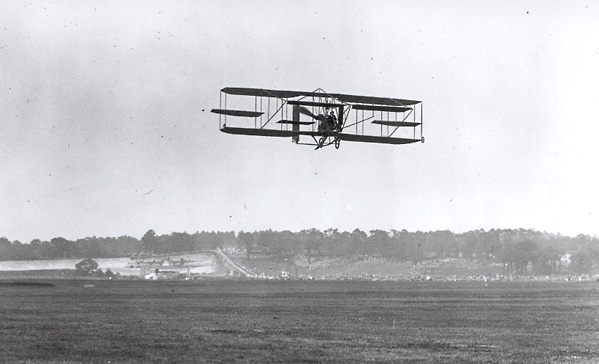 Cody 'Cathedral'. Officially 'British Army Aeroplane No.1' Samuel Cody's 1908 design was always known as the Cathedral. (The name may have been transfered from the machine's cavernous hanger to the aeroplane, or it may have been a contraction of 'catahedral' - another term for anhedral - refering to the wing style.) The Cathedral was essentially based on the formula developed by the Wrights, but was much larger and notable for its use of ailerons fitted between the wings. It made the first sustained flight in Britain on 16 October 1908 at Farnborough powered by a 50 hp Antoinette motor. The engine was subsequently changed to a 60 hp E.N.V. and with this the Cathedral made flights of over an hour in 1909. In 1910 a second Cathedral won the British Empire Michelin Trophy, and in 1911 competed in the Circuit of Britain, flying over 1,000 miles. Later models were engined with 120 hp Austro-Daimler engines and carried up to four passengers. A seaplane version was in development in 1913 when it broke up in mid-air killing Cody and his passenger.
Specifications for 1910 model:- span 46 ft. 0 in. (14 m.) - length 38 ft. 6 in. (11.7 m.) - height 13 ft. 0 in. (3.9 m.) - wing area (inc. ailerons) 640 sq.ft. (59.5 sq.m.) - take-off weight 2,950 lb. (1338 kg) - speed 65 mph (105 kph).
Cody 'Cathedral'. Officially 'British Army Aeroplane No.1' Samuel Cody's 1908 design was always known as the Cathedral. (The name may have been transfered from the machine's cavernous hanger to the aeroplane, or it may have been a contraction of 'catahedral' - another term for anhedral - refering to the wing style.) The Cathedral was essentially based on the formula developed by the Wrights, but was much larger and notable for its use of ailerons fitted between the wings. It made the first sustained flight in Britain on 16 October 1908 at Farnborough powered by a 50 hp Antoinette motor. The engine was subsequently changed to a 60 hp E.N.V. and with this the Cathedral made flights of over an hour in 1909. In 1910 a second Cathedral won the British Empire Michelin Trophy, and in 1911 competed in the Circuit of Britain, flying over 1,000 miles. Later models were engined with 120 hp Austro-Daimler engines and carried up to four passengers. A seaplane version was in development in 1913 when it broke up in mid-air killing Cody and his passenger.
Specifications for 1910 model:- span 46 ft. 0 in. (14 m.) - length 38 ft. 6 in. (11.7 m.) - height 13 ft. 0 in. (3.9 m.) - wing area (inc. ailerons) 640 sq.ft. (59.5 sq.m.) - take-off weight 2,950 lb. (1338 kg) - speed 65 mph (105 kph).
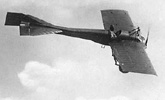 Deperdussin B. The Deperdussin B of 1911 was the first successful product of Armand Deperdussin's Société Pour les Appareils Deperdussin (SPAD) formed the previous year. An elegant and efficient monoplane, it was inspired by the Blériot XI, and found favour with racers and military pilots alike. René Vidart came third in the Circuit of Europe flying one in June, and James Valentine took the same placing in the Circuit of Britain in July. At least fourteen were bought by the British military before the First World War. Lt. J. C. Porte, RN, became the chief pilot for the British Deperdussin Company. The 'Popular' model sold to flying schools for £460. In 1912, Jules Védrines took the world air speed record to 108 mph (173 kph) in a 'Dep' at Chicago. The single-seat version was usually powered by a 50 hp and the two-seater by a 100 hp Gnôme. The airframe was constructed from ash, spruce and plywood with an oiled cotton covering.
Specifications:- span 28 ft.20 in. (8.8 m.) - length 24 ft. 11 in. (7.6 m.) -
height approx. 8 ft. 2 in. (2.5 m.) - wing area 263.7 sq.ft. (24.5 sq.m.) - take-off weight 551 lb. (250 kg) - speed 65 mph (105 kph).
Deperdussin B. The Deperdussin B of 1911 was the first successful product of Armand Deperdussin's Société Pour les Appareils Deperdussin (SPAD) formed the previous year. An elegant and efficient monoplane, it was inspired by the Blériot XI, and found favour with racers and military pilots alike. René Vidart came third in the Circuit of Europe flying one in June, and James Valentine took the same placing in the Circuit of Britain in July. At least fourteen were bought by the British military before the First World War. Lt. J. C. Porte, RN, became the chief pilot for the British Deperdussin Company. The 'Popular' model sold to flying schools for £460. In 1912, Jules Védrines took the world air speed record to 108 mph (173 kph) in a 'Dep' at Chicago. The single-seat version was usually powered by a 50 hp and the two-seater by a 100 hp Gnôme. The airframe was constructed from ash, spruce and plywood with an oiled cotton covering.
Specifications:- span 28 ft.20 in. (8.8 m.) - length 24 ft. 11 in. (7.6 m.) -
height approx. 8 ft. 2 in. (2.5 m.) - wing area 263.7 sq.ft. (24.5 sq.m.) - take-off weight 551 lb. (250 kg) - speed 65 mph (105 kph).
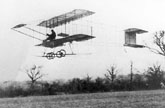 Farman
III. Henry Farman's 1909 design
took its inspiration from the Standard Voisin, which
he had flown with such success, but was slightly lighter and more manoeuvrable.
Although side panels between the wings were done away with, this type of
machine was still widely (and confusingly) referred to as a boxkite.
Construction was of ash and mahogony, with a mahogony propeller, and cotton
flying surfaces. Lateral control was provided by four large ailerons
(later reduced to two), which drooped down when the machine
was stationary but streamed out to the horizontal once flying speed was
gained. A front elevator was retained
and a single or paired rudder was
situated between the tailplanes. The top tailplane carried a secondary
elevator. The usual power-plant was the 50 hp Gnôme, which was often
attached
behind the pusher
propeller to avoid fouling with oil. Large wooden
skids supplemented the wheels. The wheels were attached to the skids with
rubber cord in such a way as that the wheels normally took the weight of
the plane. But on a hard landing they were forced up as the cords stretched
so that the shock was taken by the skids. This device made the Farman a
good aircraft for cross country flying where a rough field landing might
occur at any time. From 1910, a larger model was produced which could achieve
47 mph when fitted with the 60 hp E.N.V. engine. The Farman III
was widely imitated, by the Bristol Boxkite, Short
S.27 and Grahame-White 'Baby' among others. Specifications:-span
32
ft.10 in. (10 m.) - length 39 ft. 4.5 in. (12 m.) - height
approx. 11 ft. 6 in. (3.5 m.) - wing area 430.5 sq.ft. (40 sq.m.)
- take-off weight 1,213 lb. (550 kg) - speed 37 mph (60 kph).
Farman
III. Henry Farman's 1909 design
took its inspiration from the Standard Voisin, which
he had flown with such success, but was slightly lighter and more manoeuvrable.
Although side panels between the wings were done away with, this type of
machine was still widely (and confusingly) referred to as a boxkite.
Construction was of ash and mahogony, with a mahogony propeller, and cotton
flying surfaces. Lateral control was provided by four large ailerons
(later reduced to two), which drooped down when the machine
was stationary but streamed out to the horizontal once flying speed was
gained. A front elevator was retained
and a single or paired rudder was
situated between the tailplanes. The top tailplane carried a secondary
elevator. The usual power-plant was the 50 hp Gnôme, which was often
attached
behind the pusher
propeller to avoid fouling with oil. Large wooden
skids supplemented the wheels. The wheels were attached to the skids with
rubber cord in such a way as that the wheels normally took the weight of
the plane. But on a hard landing they were forced up as the cords stretched
so that the shock was taken by the skids. This device made the Farman a
good aircraft for cross country flying where a rough field landing might
occur at any time. From 1910, a larger model was produced which could achieve
47 mph when fitted with the 60 hp E.N.V. engine. The Farman III
was widely imitated, by the Bristol Boxkite, Short
S.27 and Grahame-White 'Baby' among others. Specifications:-span
32
ft.10 in. (10 m.) - length 39 ft. 4.5 in. (12 m.) - height
approx. 11 ft. 6 in. (3.5 m.) - wing area 430.5 sq.ft. (40 sq.m.)
- take-off weight 1,213 lb. (550 kg) - speed 37 mph (60 kph).
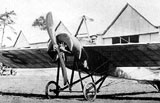 Morane-Saulnier Type G/H. The brothers Léon and Robert Morane
had begun designing monoplanes with Raymond Saulnier in 1911. In 1912,
they unveiled their highly capable Types G (two-seater) and H (single-seater).
The tractor monoplane layout was
inspired by the success of the Blériot XI
but the design was cleaner and more sophisticated. Construction was of
spruce and flattened steel tube, with a plywood and doped cotton covering.
A 80 hp Gnôme was normally fitted beneath the close-fitting cowl,
though 60 hp versions also flew. The propellor was mahogony. The type was
one of the finest monoplanes produced before the First World War, excelling
in climb, endurance, speed and reliability. In 1912 Roland Garros reached
18,405 ft. (5610 m.) over Tunis; the following year he flew 460 miles
(740 km) non-stop across the Mediterranean; Gustav
Hamel won the 1913 UK Aerial Derby with an average speed of 76 mph (122
kph) in a version with wings cropped to 20 ft. (6 m.); and in 1914, Marc
Pourpe flew 3,100 miles (5000 km) from Cairo to Khatoum
and back in under three weeks. Specifications
(for Type G):-span 30 ft. 6 in. (9.3 m.) - length 21 ft. 6 in.
(6.6 m.) - height approx. 9 ft. 0 in. (2.8 m.) - wing area
160 sq.ft. (14.9 sq.m.) - take-off weight 816 lb. (370 kg) - speed
approx. 80 mph (129 kph).
Morane-Saulnier Type G/H. The brothers Léon and Robert Morane
had begun designing monoplanes with Raymond Saulnier in 1911. In 1912,
they unveiled their highly capable Types G (two-seater) and H (single-seater).
The tractor monoplane layout was
inspired by the success of the Blériot XI
but the design was cleaner and more sophisticated. Construction was of
spruce and flattened steel tube, with a plywood and doped cotton covering.
A 80 hp Gnôme was normally fitted beneath the close-fitting cowl,
though 60 hp versions also flew. The propellor was mahogony. The type was
one of the finest monoplanes produced before the First World War, excelling
in climb, endurance, speed and reliability. In 1912 Roland Garros reached
18,405 ft. (5610 m.) over Tunis; the following year he flew 460 miles
(740 km) non-stop across the Mediterranean; Gustav
Hamel won the 1913 UK Aerial Derby with an average speed of 76 mph (122
kph) in a version with wings cropped to 20 ft. (6 m.); and in 1914, Marc
Pourpe flew 3,100 miles (5000 km) from Cairo to Khatoum
and back in under three weeks. Specifications
(for Type G):-span 30 ft. 6 in. (9.3 m.) - length 21 ft. 6 in.
(6.6 m.) - height approx. 9 ft. 0 in. (2.8 m.) - wing area
160 sq.ft. (14.9 sq.m.) - take-off weight 816 lb. (370 kg) - speed
approx. 80 mph (129 kph).
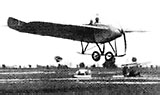 Nieuport IVG. Edouard de Niéport (1875-1911) first achieved
success with his Mark II monoplane of 1910 which acquitted itself well
at the Rheims Meet of that year. In 1911 he developed the design into a
neat two-seater, known as the IVG. The airframe was constructed from spruce,
ash and steel tube. An aluminium engine cowl and proofed linen surfaces
provided good streamlining from nose to tail. Roll control was effected
by wing-warping, with the bracing
wires gathered to a sturdy X shaped cabane.
Underneath, a single skid protected the propellor from hard landings. Power
was provided by Gnôme engines of 50-100 hp rating. The two seats
were placed in a common cockpit, so communication was possible in the air.
The type was used for one of the first military aerial reconnaisances (by
the Italians in Libya in October 1911), and examples were also bought by
the British and French armies. The IVG possessed impressive performance
for 1911. Edouard de Niéport himself set a new world speed record
with 82.7 mph (133.1 kph), and American C. T. Weymann won the Gordon Bennett
Trophy at Eastchurch on a 100 hp version in July. In 1913, Marc Bonnier
and his mechanic made an epic journey in a Nieuport IVG from France
to Cairo, a distance of some 3,500 miles (5600 km). Specifications:-
span 36 ft. 1 in. (11 m.) - length
27 ft. 7 in. (8.4 m.) - height 8 ft. 6 in. (2.6 m.) - wing area
226 sq.ft. (21 sq.m.) - take-off weight 717 lb. (325 kg) - speed
55 mph (88 kph).
Nieuport IVG. Edouard de Niéport (1875-1911) first achieved
success with his Mark II monoplane of 1910 which acquitted itself well
at the Rheims Meet of that year. In 1911 he developed the design into a
neat two-seater, known as the IVG. The airframe was constructed from spruce,
ash and steel tube. An aluminium engine cowl and proofed linen surfaces
provided good streamlining from nose to tail. Roll control was effected
by wing-warping, with the bracing
wires gathered to a sturdy X shaped cabane.
Underneath, a single skid protected the propellor from hard landings. Power
was provided by Gnôme engines of 50-100 hp rating. The two seats
were placed in a common cockpit, so communication was possible in the air.
The type was used for one of the first military aerial reconnaisances (by
the Italians in Libya in October 1911), and examples were also bought by
the British and French armies. The IVG possessed impressive performance
for 1911. Edouard de Niéport himself set a new world speed record
with 82.7 mph (133.1 kph), and American C. T. Weymann won the Gordon Bennett
Trophy at Eastchurch on a 100 hp version in July. In 1913, Marc Bonnier
and his mechanic made an epic journey in a Nieuport IVG from France
to Cairo, a distance of some 3,500 miles (5600 km). Specifications:-
span 36 ft. 1 in. (11 m.) - length
27 ft. 7 in. (8.4 m.) - height 8 ft. 6 in. (2.6 m.) - wing area
226 sq.ft. (21 sq.m.) - take-off weight 717 lb. (325 kg) - speed
55 mph (88 kph).
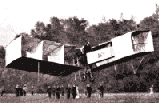 Santos-Dumont
14bis. The 14bis made the first powered flights
in Europe during the Autumn of 1906. It flew tail-first and influenced
Blériot's
first monoplane, the Canard,
which lent its name to all other such aircraft. The 14bis
was constructed from pine and bamboo poles covered with Japanese silk.
Its propeller was made from steel shafts with aluminium blades. The boxkite
cell in the nose pivoted up and down to act as an elevator
and from side to side in the role of a rudder.
The wings were rigged with 10 degrees of dihedral
and the first flights were made without ailerons.
Octagonal ailerons were fitted between the wings from November 1906, these
being controlled through a body harness worn by the pilot, who flew standing
up. The original power-plant was a 24 hp Antoinette engine, but this was
upgraded to the 50 hp version from October. The 14bis made its last
flight on 14 April 1907. Specifications:- span 36 ft. 9 in.
(11.2 m.) - length 31 ft. 10 in. (9.7 m.) - height approx.
11 ft. 2 in. (3.4 m.) - wing area 560 sq.ft. (52 sq.m.) - take-off
weight 661 lb. (300 kg) - speed approx. 25 mph (30 kph).
Santos-Dumont
14bis. The 14bis made the first powered flights
in Europe during the Autumn of 1906. It flew tail-first and influenced
Blériot's
first monoplane, the Canard,
which lent its name to all other such aircraft. The 14bis
was constructed from pine and bamboo poles covered with Japanese silk.
Its propeller was made from steel shafts with aluminium blades. The boxkite
cell in the nose pivoted up and down to act as an elevator
and from side to side in the role of a rudder.
The wings were rigged with 10 degrees of dihedral
and the first flights were made without ailerons.
Octagonal ailerons were fitted between the wings from November 1906, these
being controlled through a body harness worn by the pilot, who flew standing
up. The original power-plant was a 24 hp Antoinette engine, but this was
upgraded to the 50 hp version from October. The 14bis made its last
flight on 14 April 1907. Specifications:- span 36 ft. 9 in.
(11.2 m.) - length 31 ft. 10 in. (9.7 m.) - height approx.
11 ft. 2 in. (3.4 m.) - wing area 560 sq.ft. (52 sq.m.) - take-off
weight 661 lb. (300 kg) - speed approx. 25 mph (30 kph).
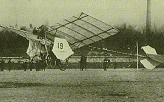 Santos-Dumont
Demoiselle. The name Demoiselle ('damsel-fly') attached to a series
of light-weight monoplane designs
by Alberto Santos-Dumont, constructed between 1907 and 1909. The first
was Santos-Dumont's No.19, which was a high wing monoplane with
a 20 hp horizontally opposed Dutheil-Chalmers engine mounted above the
wing. A single bamboo pole supported tail surfaces, which pivoted on a
universal joint to act as both elevator
and rudder. There was an auxilary
rudder either side of the pilot and an auxillary elevator between the front
wheels. There appears to have been no control in roll.
In the 19bis a 24 hp Antoinette engine was mounted between the wheels
and linked to the propeller by a drive chain. The front rudders and elevator
were deleted. There is no record that it ever flew. The 'definitive' version
of the Demoiselle was the No.20, which reverted to a wing-mounted
2 cylinder Dutheil-Chalmers engine of 35 hp, and introduced a more substantial
fuselage of three bamboo poles arranged in a triangular section and braced with
steel tube. Wing-warping
was also provided and was controlled by a body harness. Another interesting
feature was the radiator tubes which followed the underside of the wings
to improve streamlining. Several of these mature Demoiselles were sold
to enthusiasts who wanted an affordable way into aviation. The controls were extremely
sensitive, though, and the Demoiselle was only easy to fly in a dead calm.
(Compare the weight of the Demoiselle to the other aircraft on this
page.)
Specifications:-span 16 ft.9 in. (5.1
m.) - length 26 ft. 3 in. (8 m.) -
height 7 ft. 10.5 in.
(2.4 m.) - wing area 110 sq.ft. (10.2 sq.m.) - take-off weight
315 lb. (143 kg) - speed 56 mph (90 kph). [More...]
Santos-Dumont
Demoiselle. The name Demoiselle ('damsel-fly') attached to a series
of light-weight monoplane designs
by Alberto Santos-Dumont, constructed between 1907 and 1909. The first
was Santos-Dumont's No.19, which was a high wing monoplane with
a 20 hp horizontally opposed Dutheil-Chalmers engine mounted above the
wing. A single bamboo pole supported tail surfaces, which pivoted on a
universal joint to act as both elevator
and rudder. There was an auxilary
rudder either side of the pilot and an auxillary elevator between the front
wheels. There appears to have been no control in roll.
In the 19bis a 24 hp Antoinette engine was mounted between the wheels
and linked to the propeller by a drive chain. The front rudders and elevator
were deleted. There is no record that it ever flew. The 'definitive' version
of the Demoiselle was the No.20, which reverted to a wing-mounted
2 cylinder Dutheil-Chalmers engine of 35 hp, and introduced a more substantial
fuselage of three bamboo poles arranged in a triangular section and braced with
steel tube. Wing-warping
was also provided and was controlled by a body harness. Another interesting
feature was the radiator tubes which followed the underside of the wings
to improve streamlining. Several of these mature Demoiselles were sold
to enthusiasts who wanted an affordable way into aviation. The controls were extremely
sensitive, though, and the Demoiselle was only easy to fly in a dead calm.
(Compare the weight of the Demoiselle to the other aircraft on this
page.)
Specifications:-span 16 ft.9 in. (5.1
m.) - length 26 ft. 3 in. (8 m.) -
height 7 ft. 10.5 in.
(2.4 m.) - wing area 110 sq.ft. (10.2 sq.m.) - take-off weight
315 lb. (143 kg) - speed 56 mph (90 kph). [More...]
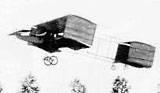 'Standard'
Voisin. The Voisin brothers, had the distinction of being the first commercial aeroplane manufacturers
in Europe when they began selling their popular biplanes in 1907. Henry
Farman was an early customer and several flew at Rheims
in 1909. Voisin machines were characterised by being safe and stable rather
than spectacular in terms of performance, and showed little development
over the years. The wings were of boxkite
construction with a varying number of cells being formed by vertical 'side-curtains'
fitted between the upper and lower wings. The tail unit was another large
boxkite cell. A monoplane forward
elevator
was mounted on the front of the fuselage. There was no control in roll
at all on most Voisins, and it was hoped by the designers that the wing
cells would supply the necessary lateral stability. Construction was from
ash and steel tube, with a plain or rubberized cotton covering. The propeller
was made from steel shafts, with aluminium blades. The engine was mounted
behind the pilot between the tail booms in a pusher
layout. Various power-plants were fitted, including 50 hp versions of the
Antoinette, E.N.V, Renault, Vivinus and Gnôme, and 60 hp versions
of the E.N.V., Gobron and Wolsey. The last standard Voisin left the brothers'
factory at Billancourt in 1911, by which time the design was obsolete.
Specifications:-span
32
ft.10 in. (10 m.) - length 39 ft. 4.5 in. (12 m.) - height
approx. 11 ft. (3.35 m.) - wing area 430.5 sq.ft. (40 sq.m.) - take-off
weight 1,323 lb. (600 kg) - speed approx. 34 mph (55 kph).
'Standard'
Voisin. The Voisin brothers, had the distinction of being the first commercial aeroplane manufacturers
in Europe when they began selling their popular biplanes in 1907. Henry
Farman was an early customer and several flew at Rheims
in 1909. Voisin machines were characterised by being safe and stable rather
than spectacular in terms of performance, and showed little development
over the years. The wings were of boxkite
construction with a varying number of cells being formed by vertical 'side-curtains'
fitted between the upper and lower wings. The tail unit was another large
boxkite cell. A monoplane forward
elevator
was mounted on the front of the fuselage. There was no control in roll
at all on most Voisins, and it was hoped by the designers that the wing
cells would supply the necessary lateral stability. Construction was from
ash and steel tube, with a plain or rubberized cotton covering. The propeller
was made from steel shafts, with aluminium blades. The engine was mounted
behind the pilot between the tail booms in a pusher
layout. Various power-plants were fitted, including 50 hp versions of the
Antoinette, E.N.V, Renault, Vivinus and Gnôme, and 60 hp versions
of the E.N.V., Gobron and Wolsey. The last standard Voisin left the brothers'
factory at Billancourt in 1911, by which time the design was obsolete.
Specifications:-span
32
ft.10 in. (10 m.) - length 39 ft. 4.5 in. (12 m.) - height
approx. 11 ft. (3.35 m.) - wing area 430.5 sq.ft. (40 sq.m.) - take-off
weight 1,323 lb. (600 kg) - speed approx. 34 mph (55 kph).
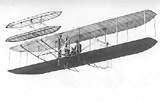 Wright Type A. When Wilbur (1867-1912) and Orville Wright (1871-1948) visited Europe in 1908-09 one of their prime goals was to enter into licence agreements with local manufacturers to produce and market their designs. In France an agreement was signed with the Société Ariel and in Britain with Short Brothers of Eastchurch. Both companies produced the passenger carrying machine Wilbur had demonstrated at Le Mans known as the Type A. The design was a biplane in every sense for it had double elevators, main plains and rudders. The rudders were placed further aft than in the brothers' 1905 design for greater controlability. The pilot sat on the wing edge with the elevator control on his left. On his right was another stick which controlled both the rudders and wing-warping (independently). As with previous Wright designs, there were no wheels, and so take offs continued to be from a wooden rail, assisted by a weight and derrick mechanism. After landing, the machine had to be carried back to the rail on a wheeled trolley. Wright motors of 24-30 hp were either built under licence or French Bariquand or Marre engines fitted. The airframe was constructed from spruce and ash, with unbleached cotton surfaces. The Type A proved popular among European aviators in 1909-10 but by 1911 it was outmoded.
Specifications:- span 36 ft. 6 in. (11 m.) - length 28 ft. 11 in. (8.8 m.) - height 8 ft. 1 in. (2.5 m.) - wing area 415 sq.ft. (38.5 sq.m.) - take-off
weight 1,200 lb. (544 kg) - speed approx. 45 mph (70 kph).
Wright Type A. When Wilbur (1867-1912) and Orville Wright (1871-1948) visited Europe in 1908-09 one of their prime goals was to enter into licence agreements with local manufacturers to produce and market their designs. In France an agreement was signed with the Société Ariel and in Britain with Short Brothers of Eastchurch. Both companies produced the passenger carrying machine Wilbur had demonstrated at Le Mans known as the Type A. The design was a biplane in every sense for it had double elevators, main plains and rudders. The rudders were placed further aft than in the brothers' 1905 design for greater controlability. The pilot sat on the wing edge with the elevator control on his left. On his right was another stick which controlled both the rudders and wing-warping (independently). As with previous Wright designs, there were no wheels, and so take offs continued to be from a wooden rail, assisted by a weight and derrick mechanism. After landing, the machine had to be carried back to the rail on a wheeled trolley. Wright motors of 24-30 hp were either built under licence or French Bariquand or Marre engines fitted. The airframe was constructed from spruce and ash, with unbleached cotton surfaces. The Type A proved popular among European aviators in 1909-10 but by 1911 it was outmoded.
Specifications:- span 36 ft. 6 in. (11 m.) - length 28 ft. 11 in. (8.8 m.) - height 8 ft. 1 in. (2.5 m.) - wing area 415 sq.ft. (38.5 sq.m.) - take-off
weight 1,200 lb. (544 kg) - speed approx. 45 mph (70 kph).
Performance data on this page from Pioneer Aircraft 1903-14 by Kenneth Munson (Blandford Press, 1969)
| <Previous |
|
Next> |
Balloons
· Airships · Zeppelins
· Santos-Dumont · Farman
· Wrights in France · The
Channel · Rheims · London
- Manchester
Chavez
· Round Britain Race · Garros
· Aerobatics · Egypt
· Men ·
Machines ·
Bibliography
& Links