The Wrights in France
While Henry Farman had been struggling to complete a kilometre in his Voisin, an aeroplane capable of flights of 25 miles had been sitting in a crate on the docks at Le Havre. This was the 1905 model Wright Flyer, sent on ahead of Wilbur Wright (1867-1912), who arrived in May 1908. In June, he chose the town of Le Mans, already famous for its motor race, as his base and began to erect the Flyer on the nearby racecourse at Hunaudières. Wilbur was ready for his first flight in Europe on 8 August.
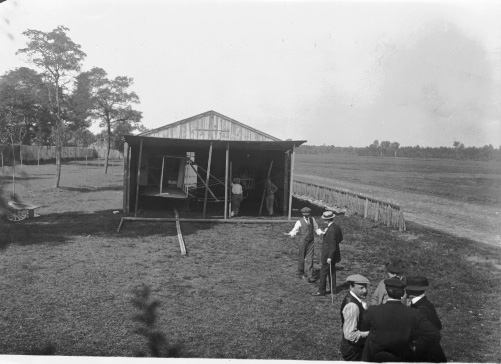
Setting
up the Flyer at Hunaudières. Nearest the shed, Wilbur (cloth
cap) is talking to Frank
Lahm
(straw boater), an American who won the 1906 Gordon
Bennett balloon race.
A
large crowd was present to watch Wilbur take to the air, which included
Ernst Archdeacon, Louis Blériot,
Léon Delagrange, Hubert
Latham and many other interested members of the French Aéro-Club.
It was late evening and the air was dead calm. Although the flight was
just a short warm-up as far as Wilbur Wright was concerned, all those present
were amazed by the display of airmanship they witnessed. All scepticism
evaporated in the minute and 45 seconds the flight took. Wilbur was only
sensible to be tentative at first. He had not flown for almost three years
and nor had the machine he was piloting. Moreover, he had just finished
modifying the control mechanism. Using the starting-rail and pillar, he
gracefully rose to 30 feet, made three smooth sweeping circuits around
the racecouse and then landed easily within 50 metres of where he had taken
off. For the spectators it was more than enough! Many of them had expected
little more a low 'hop' in a straight line. As Wilbur stepped down from
the Flyer the crowd applauded with wild enthusiasm.
| "It was at nightfall on August 8 that I saw Wilbur Wright make his first flight. He had made no flights for some months, and yet his first experiment began with the most delicate of all manoeuvres in aviation - namely, circling. He rose forthwith to a height of about 30 feet, and the spectacle was marvellous and delightful. We beheld the great white bird soar above the racecourse, pass over and beyond the trees from its shed to the winning post of the course. We were able to follow easily each movement of the pilot, note his extraordinary proficiency in the flying business, perceive the curious warping of the wings in the process of circling and the shifting position of the rudders. When after one minute 45 seconds of flight Wright again touched the ground, descending with extraordinary buoyancy and precision, while cheers arose from the crowd in the grandstand, I saw the man who is said to be so unemotional turn pale. He had long suffered in silence; he was conscious that the world no longer doubted his achievements." - Francois Peyrey |
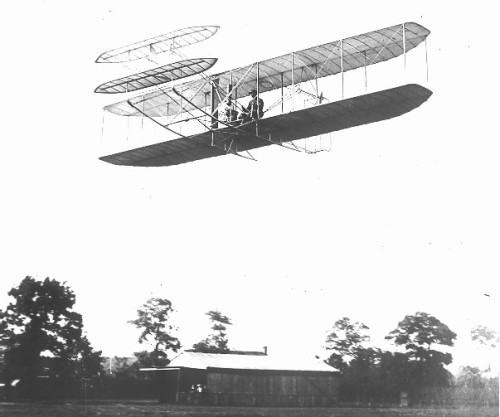
Wilbur Wright demonstrating the
Flyer
at Hunaudières, Le Mans.
Louis
Blériot told a reporter for the New York Herald on 8 August,
| "I
consider that for us in France and everywhere, a new era in mechanical
flight has begun. I am not sufficiently calm after the event thoroughly
to express my opinion. My view can be best conveyed in the words - It is
marvellous!"
"Aviation is going to make such progress as cannot be imagined." |
When they asked him how he flew aeroplanes Wilbur replied, "Like a bird." He wasn't being conceited. In these three words he summed up the difference between the Wright ethos, based on control and careful experiment, and the European, based more or less on inspired guesswork. Key to the Wrights ability in the air was their realisation of the importance that roll played in both staying level and in properly balanced turns. Whenever Wilbur made a turn, he used rudder and wing-warping together so that the Flyer banked round in an aerodynamically effecient and naturally graceful manner.
Following the flight on 8 August, Wilbur Wright became a sensation in France. Taciturn in manner, he let his flying speak for him. On 3 September, he flew for more than 10 minutes. On 16 September, he managed 29 min., 18 sec. Then he took a passenger (Ernest Zens), and made a measured flight of an incredible 41 miles in 1 hr. 32 min. on 22 September. On 6 October Wilbur made the first flight with a passenger lasting more than one hour. By 15 October, he had taken up 30 passengers, which was more than all the European aviators put together! These later flights took place at a landing ground at Auvours.
Of course, those who witnessed the flights were not content to just go up as passengers. They wanted to learn to fly like Wilbur, and so he started to give lessons. His first pupils were the Comte de Lambert, Paul Tissandier, and Capt. Lucas-Girardville.
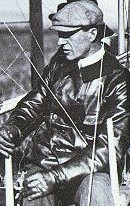 Before
the year was out, Wilbur had set the altitude record at 375 ft. (18 December),
and the distance/duration at 76.5 miles in 2 hr. 19 min. (31 December).
In fact on this last flight he had covered an unofficial 93 miles.
Before
the year was out, Wilbur had set the altitude record at 375 ft. (18 December),
and the distance/duration at 76.5 miles in 2 hr. 19 min. (31 December).
In fact on this last flight he had covered an unofficial 93 miles.