|
|
|
November 1910: Willows crosses Channel |
This Month...
in 1910 Welsh pioneer Ernest Willows made the first crossing of the English Channel from Britain to France by dirigible. The airship was his Willows III 'City of Cardiff' filled with 32,000 cu.ft. of hydrogen and powered by a 35 hp J.A.P. motor driving twin swivelling propellers. On 4 November Willows and his mechanic, Frank Godden, took off from Wormwood Scrubs at 3.25 pm, flew over central London at about 400 ft, and then headed south-east as night fell. At 2 am the next morning they landed at Douai, 170 miles from London, after 10 hrs. 35 mins in the air. [The first airship crossing of the Channel (from France to Britain) had been made on 16 October 1910 by the Frenchman Baudry.]
|
|
October 1910: Gordon-Bennett Cup |
This Month...
in 1910 British pioneer Claude Grahame-White (left) won the 2nd Gordon-Bennett Cup Race for aeroplanes. The contest took place at Belmont Park, New York on 29 October and was contested by teams from France, USA and Britain. The pilots had to cover a course of 5km 20 times. Flying a Blériot monoplane, Grahame-White averaged 62 mph to complete the course in 1 hr 4 mins. He had fitted a new 100hp engine for the race which created some problems: "...the heat ... made some of the woodwork of the monoplane's body begin to smoulder. I smelt the burning wood as I flew round the course, and saw smoke beginning to blow back," he wrote. "The situation ... was distinctly trying."
|
|
Sept 1913: la traversée de la Méditerranée |
This Month...
in 1913 young French pilot Roland Garros succeeded in making the first crossing of the Mediterranean Sea by aeroplane. Taking off from Fréjus at 5:47 a.m. on 23 September in a Morane-Saulnier 'H', he experienced engine trouble over Corsica but pushed on, keeping a careful eye on his fuel: "The level of the petrol counted out the last minutes of my endeavour like an hourglass," he wrote. "How would it end? In tragedy or glory?" Fortunately his petrol held out and Garros landed at Bizerte, Tunisia, (left) after 7 h. 53 mins. airborne during which he had covered 450 miles (730 km). Roland Garros was also a keen tennis player and the name of the stadium in which the French Open tennis competition is held now perpetuates his memory. [More]
|
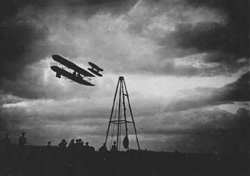 August 1908: Wilbur Wright in France
 |
This Month...
in 1908 Wilbur Wright came to France with his Type A to give public demonstration flights. The first was made at a racecourse near Le Mans, on the evening of 8 August: "We beheld the great white bird soar above the racecourse, pass over and beyond the trees from its shed to the winning post of the course," wrote eye-witness Francois Peyret, "When after 1 min 45 secs of flight Wright again touched the ground, while cheers rose from the crowd in the grandstand ... I saw the man who is said to be so unemotional turn pale. He had long suffered in silence; he was conscious that the world no longer doubted his achievements." It was a turning point for early aviation. [More]
|
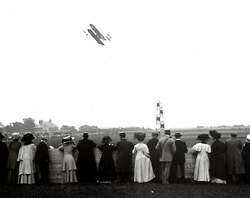 July 1910: Bournemouth Aviation Meeting
 |
This Month...
in 1910 the Bournemouth International Aviation Meeting took place. Between 11-16 July well-known pilots such as Claude Grahame-White (flying a Farman III), Leon Morane
(Blériot XI)
and Edmond Audemars (Demoiselle) participated in the various competitions, including a race to the Needles on the Isle of Wight. Morane won many of the prizes, including the speed prize with
56 mph. Sadly Charles Rolls
(co-founder of Rolls Royce) was killed on 12 July when his French-built Wright
(pictured left) suffered structural failure. A new tailplane he had fitted a few days before broke away as he was pulling out of a steep dive during the spot-landing contest. He was the first Briton to be killed in a flying accident.
|
|
May 1911: the Paris - Madrid race |
This Month...
in 1911 Jules Védrines covered 1197 km (732 miles) to win the Paris - Madrid race flying a 70 hp Morane-Borel. The route took competitors via Angoulême (Dordogne) and San Sebastian (N. Spain). "San Sebastian gave me the impression of a huge spade-cut made in the middle of Mt. Fontarabie," he wrote. "To reach the place to land you had to pass between two mountains which rose up on either side of the pass. And there, right at the bottom, I would find the little beach which served as the landing ground. These mountains ... were black with people. ... I decided to give [the crowd] ... a show.... I was still over the open sea when I cut the ignition. ... A few seconds later, I was busy between the two peaks. I passed really close to one of them ... within stone's throw of the cheering crowd." Védrines went on to win the race on 26 May in a total time of 14 h. 55 m.
|
|
April 1912: first woman to fly the Channel |
This Month...
in 1912 Gustav Hamel flew Eleanor Trehawke Davies to Paris, making her the first woman to cross the English Channel by aeroplane. The pair left Hendon (London) at 9:38 a.m. on 2 April in a two-seater Blériot XI (70 hp Gnôme) and crossed the coast at Dover around 11. Unfortunately, Miss Trehawke Davies failed in her task to ensure the pressure in the petrol system was kept up and the engine stopped in mid-Channel. Luckily Hamel had enough height to glide to a safe landing in a field at Ambleteuse, near Cap Gris Nez. After a further stop on the beach near Boulogne to keep their lunch appointment with Louis Blériot the couple set course for Paris and arrived safely at Issy-les-Moulineaux at 5.55 p.m.
|
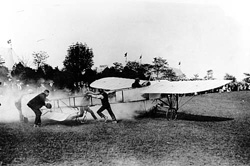 March 1911: Hendon - Brooklands
 |
This Month...
in 1911 the owners of Hendon and Brooklands put up a prize for the fastest return flight between the two London aerodromes. Four pilots attempted the task on 11 March. First off was Clement Gresswell (Blériot XI), but he was forced down by fog near Staines. Next J. V. Martin (G. W. 'Baby') made it to Brooklands, but became hopelessly lost on the return leg, landing at St. Albans 15 miles away before finding Hendon again. Maurice Ducrocq (Farman III) was forced to turn back to Brooklands at Kew by fog. Only Gustav Hamel (Blériot XI) (left) was able to find his way without problems, picking up the prize and making the 40 mile double trip in 49 mins 35 secs.
|
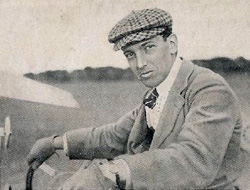 February 1905: London - Paris by balloon
 |
This Month...
in 1905 Jacques Faure and his cousin Hubert Latham (left) flew from London to Paris by balloon. Faure had originally intended to steer the balloon, named the Aéro-Club 2, with twin propellers and a 7 hp engine but in the event a free flight was made. Having inflated the 4,650 cu.ft. envelope, the aeronauts left Crystal Palace at 6:45 pm on 11 February and threw out ballast over Hastings at 8 pm to climb to 3,000 ft. for the Channel crossing. Having crossed Dieppe at 10 pm and seeing the lights of Paris on the horizon, they landed at Saint Denis at about 1 am, after 6 hours in the air. "The record of a London - Paris balloon trip has been made. It is now for others to break it," a justifiably proud Faure told reporters. [More on early ballooning]
|
|
January 1912: balloon record |
This Month...
in 1912 Émile Dubonnet (1883-1950) set a new world record for distance in a balloon. With Pierre Dupont he set off from Lamotte-Breuil, near Bordeaux, on 7 January and landed the next day in Sokolowka in what was then western Russia (now Poland). His Condor III balloon had travelled 1954 km (1,213 miles), beating the Comte de La Vaulx's existing 1900 record by a slender 18 miles. Dubonnet (left) was the son of the wealthy distiller Marius Dubonnet, and had previously represented France in the 1908, 1909 and 1911 Gordon-Bennett Cup balloon races and also taken part in aviation contests flying Tellier monoplanes. [More on early ballooning]
|
|
December 1912: a winter flight! |
This Month...
in 1912 Pierre Verrier (pilot) and Lt. Gilbert Mapplebeck (passenger) undertook an adventurous winter flight from Hendon to Brooklands. Although the distance between the two London aerodromes was only 20 miles, the flight was made in the teeth of a 45 mph south-westerly gale. Since their Maurice Farman MF.7 "Longhorn" (70 hp Renault) had a top speed of 55 mph, this meant the flight took 2 hr. 10 mins, giving an average ground speed of 9 mph! Clement Gresswell, following them in a car, was forced to stop several times to allow the aeroplane to catch up.
Many thanks to Joe Gertler for allowing me to use Charles Hubbell's beautiful watercolour of Verrier's MF.7: see http://www.memaerobilia.com/hubbellwater.asp for more.
|
|
November 1907: the Bleriot VII |
This Month...
in 1907 experimenter Louis Blériot flew his seventh design of aircraft in 'hops' of 500 metres at Issy near Paris. Despite the short distances covered, the 50 hp Antoinette-powered Blériot VII was to be of fundamental importance to the history of aviation. For the first time it brought together a monoplane layout with a tractor propeller, a fully enclosed fuselage and internally braced wings: a configuration that would be used in thousands of aircraft up to the present day. In the short term the VII was wrecked in landing on 18 December, but from it Blériot went on to develop his Channel-crossing Type XI of 1909.
[More on early Blériot types...]
|
|
October 1908: the first cross-country |
This Month...
in 1908 Henry Farman made the first cross-country flight anywhere in the world. On 30 October 1908 he flew the 27 km (17 miles) from his practice field at Bouy to the cavalry ground at Rheims in his modified Voisin biplane. Tall trees were cleared with difficulty, as he recalled: What, I asked myself, am I going to do when I arrive above those large poplars that I can see way over there... Should I pass them on the right? on the left? My indecision does not last long, for I am scarcely 50 yards from the vast high grove. Oh well, here goes! A touch on the elevator and the aircraft rises up rapidly; it goes over, while with an anxious eye I look to see whether I am clearing the tree-tops. [More...]
|
|
September 1910: over the Alps |
This Month...
in 1910 Peruvian Georges Chavez made the first flight over the Alps. Starting from Brig in Switzerland, on 23 September, Chavez followed the Simplon Pass reaching an altitude of 6,600 ft. before descending down a rocky gorge to Domodosola in Italy. He was well prepared for the flight - having set a new world altitude record of 8,487 ft. on 8 September. Chavez's intention was to carry on towards Milan to take part in the aviation meeting there. Tragically however his Blériot XI monoplane suffered structural failure just as he was gliding into the landing field at Domodosola. Chavez died of his injuries, and his last words were reportedly, "Arriba, siempre arriba" ('Higher, always higher'), which is now the moto of the Peruvian Air Force. [More...]
|
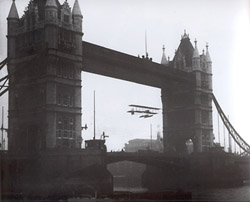 August 1912: through Tower Bridge
 |
This Month...
in 1912 Frank McClean piloted a Short S.33 sea plane through Tower Bridge and then underneath every other bridge to Westminster. McClean left the Isle of Sheppey in the Thames Estuary at 6:30 a.m., on 10 August, and came down below 150 ft. near London in order to be out of the smoke from the factory chimneys. Reaching Tower Bridge at 7:50, he 'bounced' his floats going under Blackfriars railway bridge to loud cheers from spectators, and almost grazed his wingtips under Waterloo Bridge. Although prevented by the police from repeating the feat on his return journey, McClean had achieved his aim of beating French pilot André Beaumont in making the first 'hydro-aeroplane' flight to London. In 1914 McClean moved up a notch - flying up the Nile to Khartoum.
|
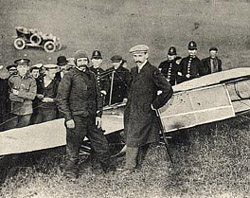 July 1909: Blériot flies the Channel
 |
This Month...
in 1909 Louis Blériot made the first aeroplane crossing of the English Channel to win the Daily Mail's £1,000 prize. Despite blustery conditions, poor visibility and the lack of a compass, on 25 July Blériot took off at 4:30 a.m. from a field near Calais and crash landed 37 mins later in Northfall Meadow near Dover Castle (picture left). He flew his 11th design of flying machine, the Blériot XI, powered by a 3-cylinder 25 hp Anzani engine, which gave a cruise speed of about 40 mph. A few days earlier, rival pilot Hubert Latham had made an unsuccessful attempt which ended with a ditching in the Channel. On 29 July, Latham made another attempt in his Antoinette, but luck was not with him as he was forced to ditch a 2nd time within sight of the English coast.
[More...] |
 June 1912: Circuit d'Anjou
 |
This Month...
in 1912 young pilot Roland Garros battled through the elements to win the French Aero-Club's Prix d'Anjou. The race had started on 16 June as the annual Grand Prix de l'Aéro-Club de France over a 190 km (120 mi.) triangular course Angers - Cholet - Saumur, but conditions were so severe that overnight the rules had to be changed and the race shortened in the interests of safety. Of the six starters (who included Gustav Hamel), only two completed the first day's flying. Garros had taken off in a 43 mph (72 kmh) gale, flown through a downpour and been engulfed by a hail storm. Each lap of the course took him about 2.5 hours to complete. "[The] third lap was a sweet relaxation compared to the first two," he recalled. His machine was a lightened 50 hp Gnôme Blériot XI, which was supervised in the field by a team of mechanics led by Louis Blériot in person. On the second day, the weather was kinder and Garros was able to complete a further four laps to claim the 75,000 franc prize. He also cemented his reputation as an excellent pilot and impressed the military with the Blériot's ability to fly in any weather with a heavy load of petrol.
|
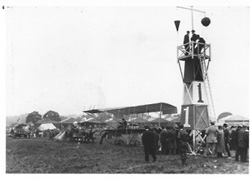 May 1911: Brooklands - Brighton
 |
This Month...
in 1911 the first race between Brooklands and Brighton took place, for a prize of £80. On 6 May, Graham Gilmour (flying a Bristol Boxkite) took off, followed by Lt. Snowden-Smith (Farman biplane), Howard Pixton (Avro biplane) and Gustav Hamel (Blériot XI) according to a handicap system devised in advance. The race from London to the south coast was easily won by Hamel who reached the finishing post at the Palace Pier in 57 min. 10 secs. Gilmour came second, taking 1 hr. 37 mins. to cover the 40 miles (a ground speed of 25 mph). Snowden-Smith was disqualified for missing the turning point at Shoreham, and Pixton finished last after getting lost and landing at Plumpton to ask the way.
|
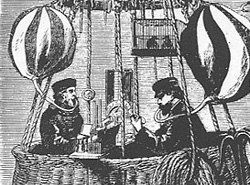 April 1875: The Zenith Tragedy
 |
This Month...
in 1875 an early balloon ascent was made above 25,000 ft. with sadly fatal results. The Zenith took off from Paris on 15 April 1875 piloted by Théodore Sivel, assisted by Jospeh Crocé-Spinelli and Gaston Tissandier. The balloon rose to an estimated 28,000 ft in an attempt to beat the altitude record set by British aeronauts Henry Coxwell and James Glaisher in 1862. But despite the presence in the Zenith of oxygen apparatus both Sivel and Crocé-Spinelli succumbed to the effects of hypoxia and cold. Only the younger Tissandier returned to earth alive, and the tragedy effectively put an end to this first Victorian phase of engineless high altitude exploration.
[Read Tissandier's account...]
|
|
March 1912: London - Paris |
This Month...
in 1912 Henri Salmet, the chief instructor of the Blériot Company's School at Hendon, decided to visit Louis Blériot in Paris by air. Despite never having made a cross-country flight before, Salmet (left) set off on 7 March 1912 in windy conditions from London flying his personal Blériot XI. He crossed the coast at Eastbourne and climbed to 6,000 ft (2000 m) to find smoother air. "The sight at that height was most marvellous - I think absolutely the best something I have seen in my life. At that height the clouds were more like big snowy mountains and flying through them was the most curious experience that could happen to anyone. A glance behind showed my wake in a swirl of fog disturbed by the propeller and the passage of the machine," he wrote later for Flight. Salmet descended through clouds near Dieppe to 650 ft (200 m) and (after stopping for directions) flew a compass course to Paris, where he landed on the parade ground at Issy-les-Moulineaux, near the Eiffel Tower. After meeting Blériot he attempted to make the return journey the same day, but was frustrated by strong head-winds. (The first non-stop London-Paris flight had been made by fellow Blériot instructor Pierre Prier in April 1911.)
|
|
February 1914: Berliner's balloon record |
This Month...
in 1914 engineer Hans Berliner set a new world distance record for gas balloons of 3,053 km (1,897 miles), which remained unbroken until the 1970s. On 8 February he took off from Bitterfeld in Germany, accompanied by Alexander Haase and Arnold Nicolai, in the balloon 'Siemens Schuckert' of 1,680 cu. m. capacity. That night they crossed the Baltic coast, heading for Russia. "Ahead, the lighthouse at Rixhoeft shines ghostly for us, and soon we hear rain showers falling distantly on the sea. At 11 o' clock we leave the mainland and our native coast disappears gradually in the evening mist. Soon we also lose the beacon on the Hela peninsula. Now we are all alone, between water and sky," he wrote. The next day a gale force wind swept the balloon deep into Russia over the Ural Mountains. It finally landed in deep snow near the town of Kirgischan, 150 km west of Jakaterinburg, after 47 hours in the air. Here, the fliers were promptly arrested by Russian secret police as spies and thrown in jail. After 3 months they were able to buy bail for 12,500 gold marks. Berliner returned to Germany in May, where he had been given up for dead; a few weeks later Russia and Germany were embroiled in the 'Great War'.
Berliner's account of the epic flight, in German, can be found at http://home.t-online.de/home/heinrich.scheuermann/ballon.htm
It can be translated (after a fashion) with Babelfish http://world.altavista.com
|
 January 1912: naval experiments
 |
This Month...
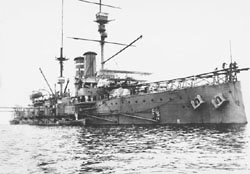
in 1912 Sub-Lt. Charles Samson flew a Short S.38 off the fore-deck of HMS Africa. The battleship, fitted with a 100 ft. wooden take off ramp (left), was moored in the River Medway for the experiment. Samson's aircraft had both floats and wheels, enabling it to land on either water or land. On 10 January 1912, Samson successfully flew off from the ship and landed at the nearby Royal Aero Club flying ground at Eastchurch. It was the first time an aeroplane had been launched from a Royal Navy ship. On 9 May, Samson repeated the feat from HMS Hibernia while she was underway. The first landing on a moving vessel, however, did not take place until 1917. |
 December 1912: Just dropped in ...
 |
This Month...
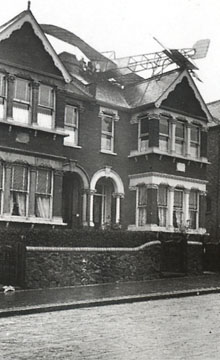
in 1912 a French pilot named Manio landed unexpectedly on the roof of a house in Palmer's Green, north London. He was on the last leg of a flight from Paris to Hendon on 7 December when engine trouble forced his Blériot XI down. Fortunately, no one (including the pilot) was hurt. Such an incident had been discussed in the correspondence pages of The Times as early as April 1910:
Sir, -- Motor-cars are bad enough, but they do not come into one's home or garden. With aeroplanes total strangers may drop in, through the roof, for a little chat at any time. I fear the law cannot protect one against such intrusion. If aviation becomes popular I shall have spikes, with long strong prongs, fixed to the chimneys of my house, and the word "Danger" painted in large red letters on a flat part of the roof. If any flying machines come down in my garden I shall send for the police to remove the occupants, whom I shall sue afterwards for any damage to my trees and shrubs.
I am, Sir, your obedient servant,
H. B. Davey,
Syracuse Lodge, Torquay |
(Letters to the Editor, 27.4.1910) |
 August 1909: the Rheims Air Meet
 July 1911: the 3rd Gordon Bennett Trophy
 April 1910: the London to Manchester race
 Feb. 1906/07: C. F. Pollock crosses the Channel
 Jan. 1908: the first kilometre flight in Europe