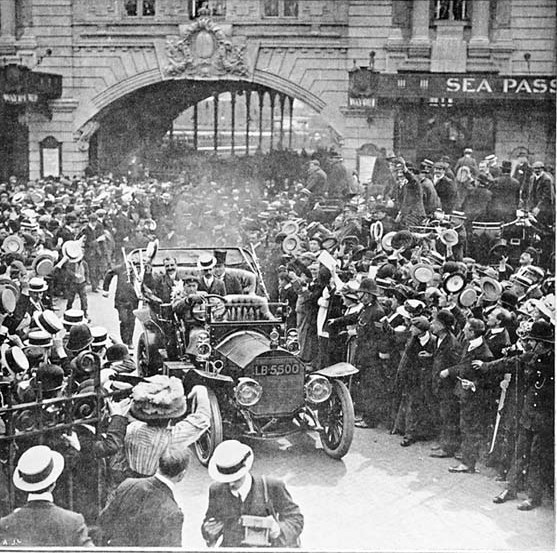
Blériot Flies the Channel
| Balloons |
| Airships |
| Zeppelins |
| Santos-Dumont |
| Henry Farman |
| Wrights in France |
| The Channel |
| Rheims |
| London-Manchester |
| Chavez flies Alps |
| Round Britain Race |
| Roland Garros |
| Aerobatics |
| Europe to Egypt |
| The Men |
| The Machines |
| Bibliography & Links |
In July 1909 three competitors assembled on the cliffs near Calais in an attempt to win the money, and the glory of the first Channel crossing by aeroplane.
The Comte
de Lambert
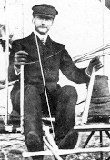 |
Charles, Comte de Lambert (1865-1944) was a Russian aristocrat although he also had roots in France. In the 1890s he had experimented with building power-boats and in the new century he had become fascinated by aviation. He was taught to fly by Wilbur Wright at his flying school at Pau and he joined fellow aristocrats, the Comte de La Vaulx and the Comte de Castillon de Saint Victor, in the French Aéro-Club. He proved to be one of Wilbur's best pupils and was the owner of two Wright Type A biplanes. |
Hubert
Latham
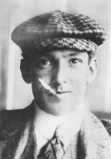 |
Hubert Latham (1883-1912) was a wealthy young Frenchman who threw himself into various activities after studying at Oxford. His adventurous pastimes included big game hunting in Africa and (like de Lambert) power-boat racing, which was how he first met fellow pioneer Léon Levavasseur. Levavasseur was a talented engineer who had developed a light-weight motor and designed an aeroplane, the Antoinette, built around it. After seeing Wilbur Wright fly at Le Mans in 1908 Latham decided to turn his hand to piloting. He bought shares in Levavasseur's Antoinette company and became in effect its chief pilot. His dashing and flambuoyant character made him a favourite with the public on both sides of the Channel. |
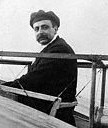 |
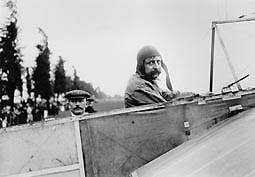
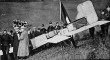
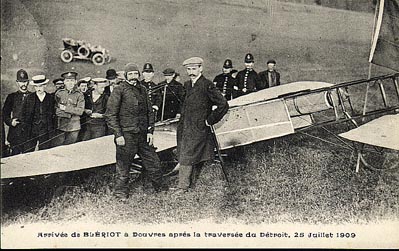
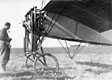
Louis Blériot (1872-1937) was born in the north French town of Cambrai. He studied engineering, and went on to make a small fortune manufacturing headlamps for the booming automobile industry. However, his 'great passion' for aviation rapidly ate into his wealth as he built and crashed a wide variety of aeroplanes between 1900 and 1909 with undiminished enthusiasm! By the summer of 1909 he had developed a reasonably airworthy monoplane, his No.XI, but his finances were in such a poor state that he needed to win the prize money if he was to continue his interest in aviation at all. |
Latham's First Attempt
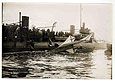
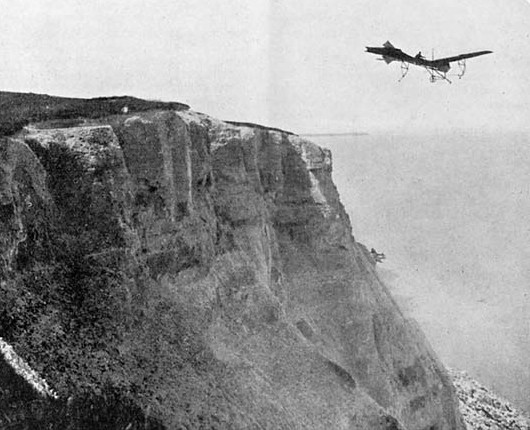
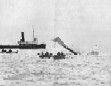
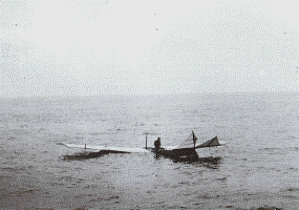 The
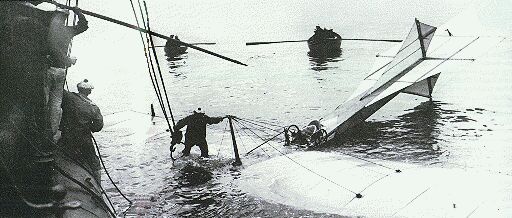
French Government had detailed a destroyer, named the Harpon, to
act as a rescue vessel. When she finally steamed up to him, the crew found
Latham cooly smoking a cigarette in mid-Channel. Although Latham had been
able to put the Antoinette down on the water with minimal damage,
it received a rough handling from the French sailors and was practically
wrecked being brought on board. Latham was forced to send to Paris for
a new machine, which meant a delay of several days.
The
French Government had detailed a destroyer, named the Harpon, to
act as a rescue vessel. When she finally steamed up to him, the crew found
Latham cooly smoking a cigarette in mid-Channel. Although Latham had been
able to put the Antoinette down on the water with minimal damage,
it received a rough handling from the French sailors and was practically
wrecked being brought on board. Latham was forced to send to Paris for
a new machine, which meant a delay of several days.